
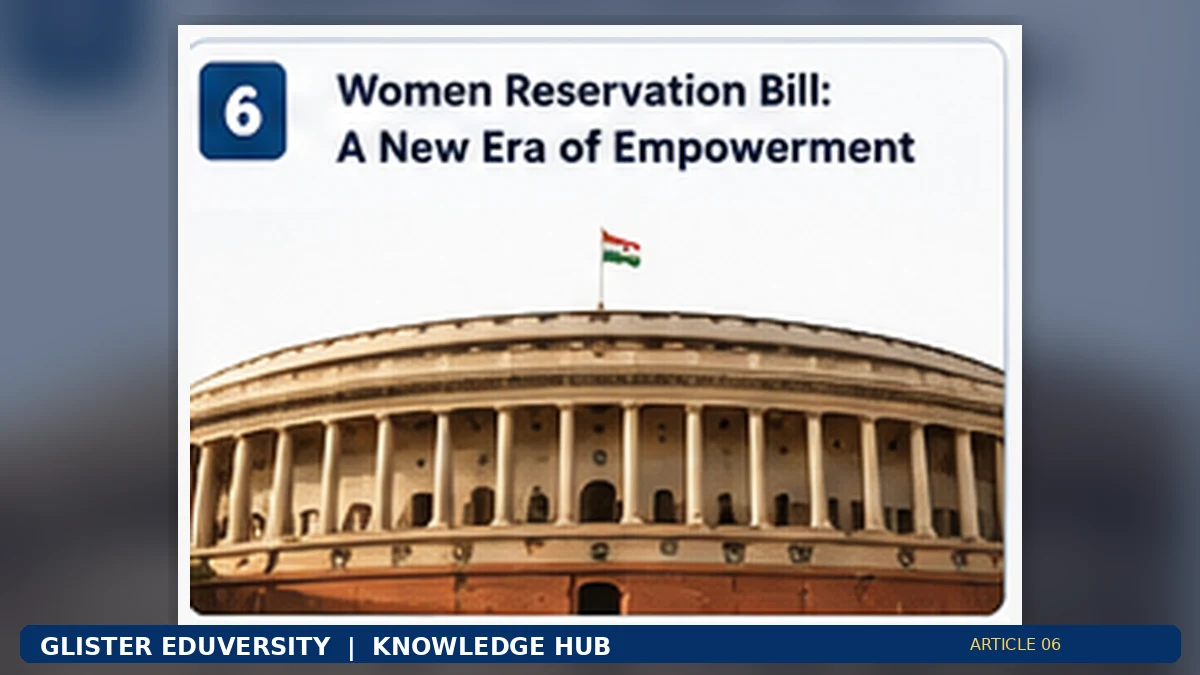
Current-affairs explainer | Updated for the 2026 context
The Constitution (One Hundred and Sixth Amendment) Act, 2023 provides for reservation of approximately one-third of directly elected seats for women in the Lok Sabha, state legislative assemblies and the Legislative Assembly of Delhi, including a share within seats reserved for Scheduled Castes and Scheduled Tribes.
Why This Topic Matters Now
The law also provides that the reservation will take effect after a delimitation exercise conducted following publication of the relevant figures of the first census after the amendment. This means the constitutional promise and its practical implementation are connected to later institutional steps.
Key Points to Understand
- The amendment inserted constitutional provisions for women’s representation.
- The reservation covers the Lok Sabha, state assemblies and Delhi Assembly.
- Implementation is connected to census figures and delimitation.
- Reserved constituencies are expected to rotate according to future law.
- Representation can influence priorities, participation and democratic legitimacy.
Opportunities and Positive Possibilities
- More women in legislatures can broaden perspectives in public decision-making.
- Political parties may invest more in leadership development for women.
- The debate can stimulate attention to representation at all levels of governance.
Challenges and Questions That Need Attention
- Implementation timing depends on complex constitutional and administrative steps.
- Reservation alone does not remove financial, social and organisational barriers.
- Parties must avoid treating women candidates as symbolic or temporary representatives.
What Students and Young Professionals Should Learn
- Read the constitutional text before accepting simplified claims.
- Distinguish between enactment, commencement and operational implementation.
- Study how delimitation changes constituency boundaries.
- Examine representation using evidence rather than slogans.
Conclusion
The amendment is a major constitutional commitment, but its democratic value will depend on timely, fair and transparent implementation. Representation should also be supported by stronger political participation, leadership opportunities and institutional respect for women.
Sources and Further Reading
This article is an educational explainer based on publicly available official or authoritative material. Readers should consult the latest source documents for updates.