
Current-affairs explainer | Updated for the 2026 context
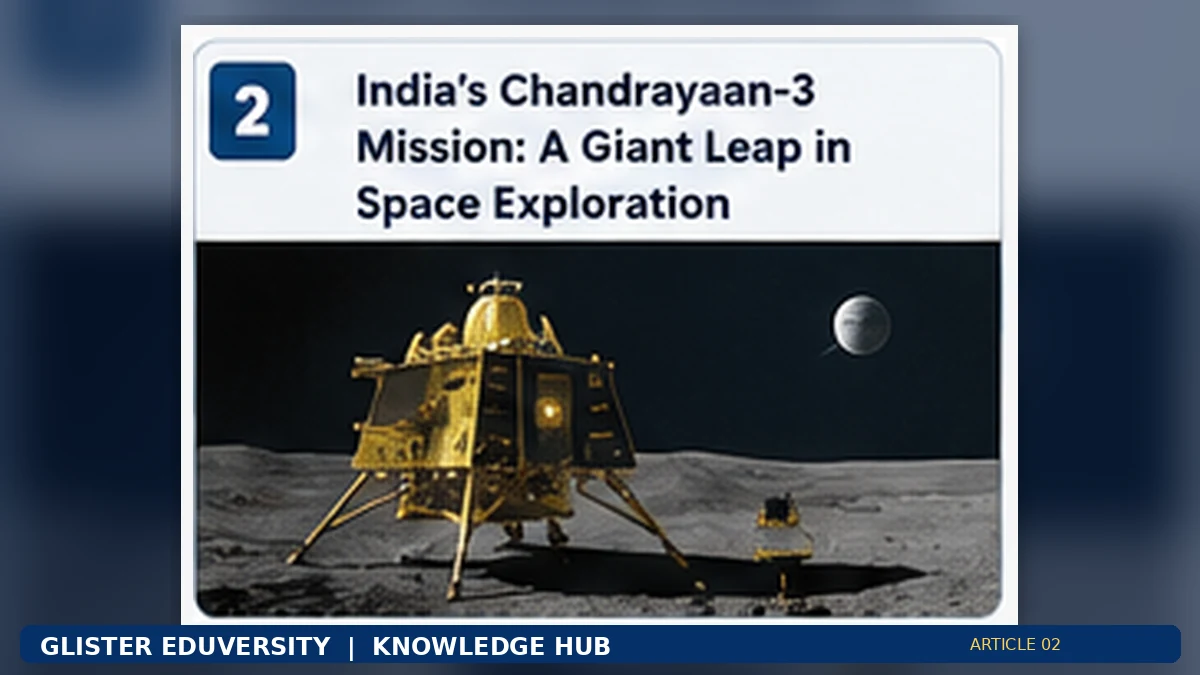
Chandrayaan-3 demonstrated India's capability to carry out a controlled soft landing and operate a rover on the lunar surface. The mission combined an indigenous propulsion module, lander and rover, and was designed to prove technologies required for future interplanetary missions. Its success became a major scientific and engineering milestone for India.
Why This Topic Matters Now
The mission remains relevant in 2026 because it created technical knowledge, public confidence and new scientific questions. Its landing and surface operations showed the value of testing, redundancy, simulation and teamwork. It also expanded student interest in aerospace engineering, robotics, remote sensing, planetary science and data analysis.
Key Points to Understand
- The mission aimed to demonstrate safe and soft landing on the Moon.
- The Pragyan rover conducted in-situ observations of the lunar surface.
- The lander and rover carried scientific payloads for surface experiments.
- The propulsion module supported lunar transfer and also carried the SHAPE payload.
- The mission demonstrated systems engineering across launch, navigation, landing and surface operations.
Opportunities and Positive Possibilities
- Indian institutions can build stronger programmes in planetary science and space technology.
- Startups can work in sensors, robotics, materials, satellite systems and geospatial applications.
- Students can access ISRO outreach, internships, projects and STEM initiatives.
Challenges and Questions That Need Attention
- Space missions require long development cycles and rigorous quality control.
- Scientific success must be followed by open analysis, publications and sustained research funding.
- Public excitement should not replace an understanding of uncertainty and mission risk.
What Students and Young Professionals Should Learn
- Build strong foundations in mathematics, physics, programming and electronics.
- Study mission objectives rather than only launch-day headlines.
- Learn how multidisciplinary teams solve complex problems.
- Use official mission pages and scientific results for accurate information.
Conclusion
Chandrayaan-3 was not simply a symbolic achievement. It was a practical demonstration of engineering capability and a platform for future scientific progress. Its greatest educational value lies in showing how disciplined learning, repeated testing and collaboration turn ambition into achievement.
Sources and Further Reading
This article is an educational explainer based on publicly available official or authoritative material. Readers should consult the latest source documents for updates.